How to Reduce No-Shows in a Teletherapy Practice
No-shows are the largest controllable drain on a teletherapy practice. Most of them come from a handful of fixable causes, and almost none of them are indifference.
By The Blink Session Team · Updated August 17, 2026
An empty session slot is the most expensive thing in a therapy practice. The clinician's time is already committed, the room is already blocked, and the revenue is simply gone. For a solo teletherapy practice, a few no-shows a week is the difference between comfortable and precarious.
The useful thing about no-shows is that most of them have specific, fixable causes. Very few are about a family not caring.
Make joining trivially easy
Start here, because it is the cheapest fix with the largest effect.
Every barrier between a reminder and a live session costs you attendance. A family that has to find an email, locate a link, install software, create an account, and grant camera permission has five opportunities to give up, and one of them will be at the exact moment their toddler needs something.
The target is one tap. The reminder contains the join link; tapping it opens the session in the browser. No download, no login, no account.
Get reminder timing right
One reminder is not enough and five is noise. What works for most practices:
- Twenty-four hours ahead. Long enough to reschedule rather than simply miss.
- One to two hours ahead. Catches the family whose day has drifted.
Include the join link in every reminder, and send by both email and text where you can. Text substantially outperforms email for the same-day reminder.
Schedule around real family routines
A slot that fights a family's routine will lose, every week, no matter how committed they are.
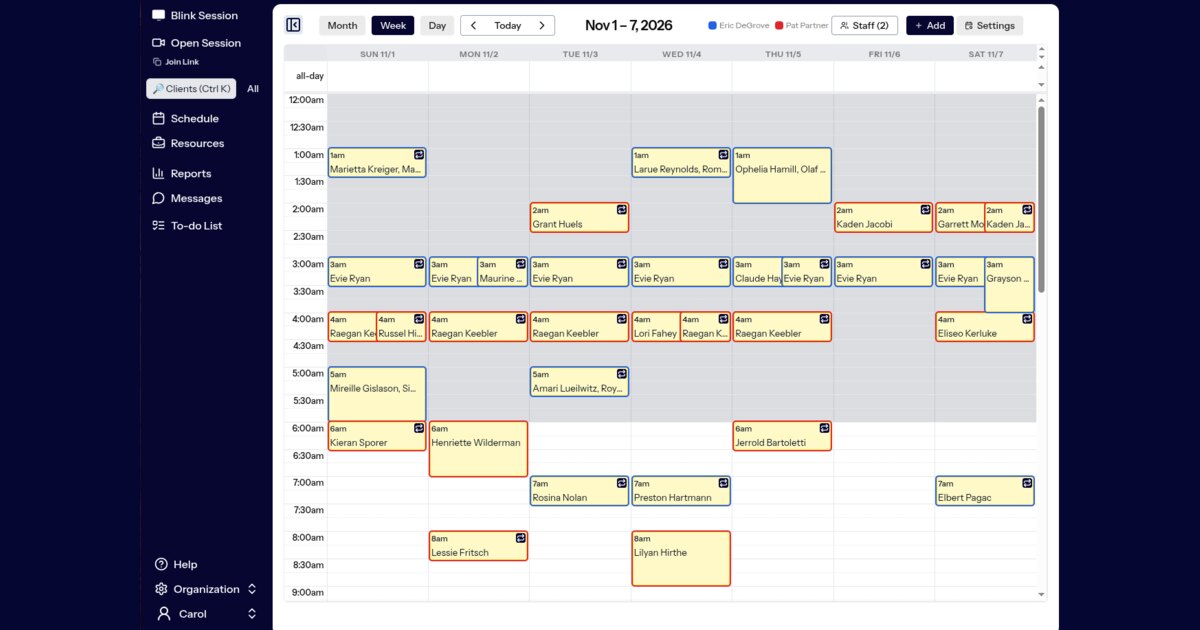
The 4pm appointment that collides with a sibling's school pickup will be missed repeatedly. So will the 8am slot for a family with a difficult morning routine. When a client no-shows twice at the same time of day, the problem is usually the slot rather than the family. Ask.
Recurring appointments at a consistent weekly time outperform ad-hoc scheduling, because they become a fixture rather than something to remember.
Do a real technology check at intake
A large share of first-appointment no-shows are not no-shows at all. The family tried to join and could not.
Spend ten minutes before the first session confirming that the device works, the camera and microphone are permitted, the connection holds, and the caregiver knows what tapping the link will do. Also tell them what to do when it fails: who to call, and whether you will switch to phone.
Set expectations at intake, in writing
Cover, in plain language: what the session will involve, how long it runs, what the caregiver's role is, your cancellation window, your no-show policy, and what happens if the technology fails.
Families rarely violate expectations they actually understood. Most policy conflict comes from an expectation that was never stated.
Have a policy, and apply it consistently
A no-show policy exists to protect the practice, not to punish clients. Reasonable shape:
- A clear cancellation window, commonly twenty-four hours.
- A stated fee for late cancellations and no-shows, disclosed and agreed at intake.
- Discretion for genuine emergencies, because rigidity here damages relationships that matter.
- A conversation, not an escalating fee, when a pattern emerges.
Consistency is what makes a policy work. A fee waived every time it is invoked is not a policy.
Follow up on a miss the same day
A same-day message after a missed session does two things: it often surfaces a fixable cause, and it signals that the appointment mattered.
Keep it non-accusatory. "We missed you today, is everything all right? Want me to send some other times?" gets you a real answer. It also frequently reveals that the family was in the waiting room the whole time and something on their end failed.
Watch the pattern, not the incident
One no-show is noise. Three at the same time of day, or a run of misses from a family that used to attend reliably, is data.
Look for the cause. A schedule change at work, a change in the child's school day, a device that broke, a caregiver who no longer feels able to support the session, or waning buy-in about whether therapy is helping. Each has a different fix, and none of them is a fee.
Make the value visible
Families that can see progress keep showing up. Families who cannot tell whether anything is changing drift, and the drift shows up as attendance.
Share progress data. Point to the specific goal that moved. Send home practice that connects the session to something the caregiver can observe at the dinner table. Attendance is downstream of perceived value more than of any reminder system.